

We have been receiving an increasing number of inquiries from high-earning individuals—such as executives at foreign affiliates and major domestic corporations about the tax saving strategies. This time I will propose one tax saving scheme by real estate investment in Japan.
【Question】 I am interested in tax benefits by investing in real estate in Japan. Can you explain specific strategies and risks of starting real estate investment in Japan.
I am executive officer at Japanese company and my base annual compensation will be ¥25 million and receive around ¥10 million in Restricted Stock Units (RSUs). I may have income and inhabitant payment due about \15 million yen. One of my friends recommended me real estate investment in Japan for tax benefits.
【Answer】 Investment in Tokyo Urban Condominium to claim income tax refunds and future capital gains from selling the property
First, it is important to note how RSUs are taxed. For domestic Japanese companies, stock vested through RSUs is subject to employment income tax and is generally withheld at the source by the company.
On the other hand, when RSUs are vested by the overseas headquarters of a foreign affiliate, tax is not automatically withheld from your regular paycheck. Therefore, you are required to file an annual tax return (Kakutei Shinkoku).
In either case, if you choose to hold the vested shares without selling them, you must be prepared to pay the corresponding income tax in cash (out-of-pocket).
When high-income earners consider real estate investment, their approaches generally fall into two major categories depending on their goals:
Pattern 1: Tokyo Urban Condominium Investment
This method aims to offset the accounting losses from real estate income against high salary income (known as loss offset or “Son-eki Tsusan”) to claim income and inhabitant tax refunds through a tax return, while also anticipating future capital gains from selling the property.
- Pattern 2: Regional En-bloc (Whole Building) Apartment Investment
This method focuses heavily on yield, aiming to accumulate steady, monthly “income gains” (rental revenue).
In this article, we will focus on the frequently requested “Pattern 1: Tax Saving and Investment Scheme via Tokyo Urban Condominium” and explain the key points and tax precautions from an expert’s perspective.
【Amalysis】
1. Financing and Judging the ROI for Tokyo Urban Condo Investments
The primary objective of this scheme is to generate an accounting deficit by heavily utilizing property “depreciation costs,” thereby offsetting your salary income to reduce taxes.
The ideal targets for this strategy are recently built, family-type (such as 2LDK) sectional condos in central Tokyo (close to station), which maintain high asset value and liquidity.
In many cases, your monthly expenses (repayment of principal and interest, management fees, and property taxes) will exceed your monthly rental income, resulting in a temporary cash outflow (deficit). However, the investment is considered cost-effective if the final cash-in-hand upon sale (selling price minus remaining loan balance) plus the total amount of annual tax refunds combined exceeds the cumulative total of your past cash outflows.
1.1 Financing (Loans): Real estate loan interest rates is around 2.5% (as of May 2026). It is typical to cover about 10% to 20% of the initial costs as a down payment (self-funding) and finance the remainder.
“If you are targeting a recently built 2LDK property in central Tokyo—such as in Chiyoda, Minato, or Shibuya wards—you should anticipate an investment of around ¥200 million, which requires preparing ¥20 million to ¥40 million in cash as a down payment.”
1.2 Loan Term: While it is generally calculated based on the “statutory useful life minus elapsed years,” some financial institutions may allow long-term loans of 40 years or more depending on the lender and the building’s structure (such as reinforced concrete).
2. Crucial Tax Benefits and Pitfalls to Keep in Mind
2.1 Holding the Property for “Over 5 Years” is the Golden Rule of Exit Strategies
The tax rate applied to capital gains (capital gains tax) when selling real estate changes drastically depending on the holding period.
- Short-term Capital Gains (Held for 5 years or less): Tax rate 39.63%
- Long-term Capital Gains (Held for over 5 years): Tax rate 20.315%
To optimize your returns, you should avoid selling within 5 years—where the highest tax rate applies—and adopt a basic strategy of holding the property for over 5 years (specifically determined as of January 1st of the year of sale) to cap the tax rate at approximately 20%.
【Reference Tax Answers (National Tax Agency)】
2.2 Income Splitting via Salary to Family Members (Salary for Blue Return Employees)
If you are married and your spouse is currently unemployed (e.g., a full-time homemaker), you can file a “Blue Tax Return” for your real estate business. This allows you to pay your spouse a salary as a “Blue Return Employee” and deduct it as a business expense.
However, owning just a single condo unit is often not recognized as a “business-scale” enterprise (which generally requires a minimum of 5 buildings or 10 units), risking disqualification by the tax office. If you are considering this, it’d be better considering payment to your spouse when reaching the “business-scale”.
【Reference Tax Answer】
2.3 Deducting Home Rent as an Expense (Business-Home Allocation)
If your current residence is a rented property and you use a portion of it as an “office” or study for your real estate investment business, you can deduct a portion of your rent as a business expense. This must be calculated using a reasonable standard, such as floor space ratio or usage hours.
【Reference Tax Answer】
2.4 Deducting “Interest Payments” on the Building Portion
Interest paid on real estate loans is also deductible as an expense. However, there is a crucial catch: if your real estate income falls into a deficit, the portion of interest corresponding to the loan used to acquire the land cannot be offset against your salary income. Therefore, it is vital to accurately verify the ratio between the “building” and “land” values in your purchase contract.
【Reference Tax Answer】
3. Case Study: Purchasing a 2LDK Unit on the 8th Floor of “The Parkhouse Ebisu”
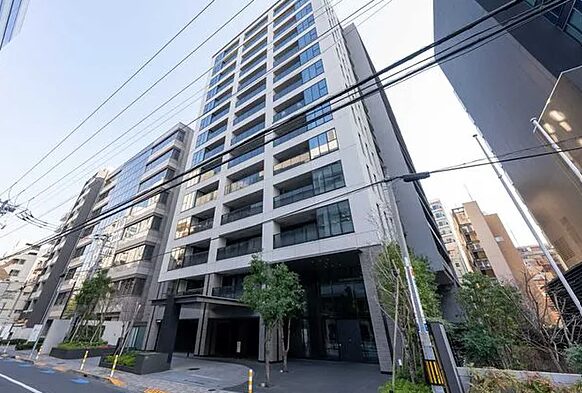
Let’s conduct an investment simulation for a recently built, pre-owned 2LDK condo (55 sqm) on the 8th floor of “The Parkhouse Ebisu”—a premium residential series originally developed by Mitsubishi Jisho Residence. Boasting a prime location just a 4-minute walk from Ebisu Station and aged 7 years (as of May 2026), this simulation assumes a holding period of 6 years before selling.
【Assumed Conditions】
・Total Investment: ¥199.8 million
・Loan Amount: ¥169.83 million (85% of total investment)
・Loan Terms: Real estate loan at 2.5% interest, 35-year term, Principal Equal Payment (Gankin Kinto)
・Estimated Rental Income: ¥4.8 million per year (Gross Yield: 2.4%)
・Tax Refund Rate: 50% (Income Tax 40% + Inhabitant Tax 10%)
・Selling Price after 6 Years: ¥219.78 million (Assuming a 10% appreciation from the initial investment due to inflation)
【Investment Analysis】
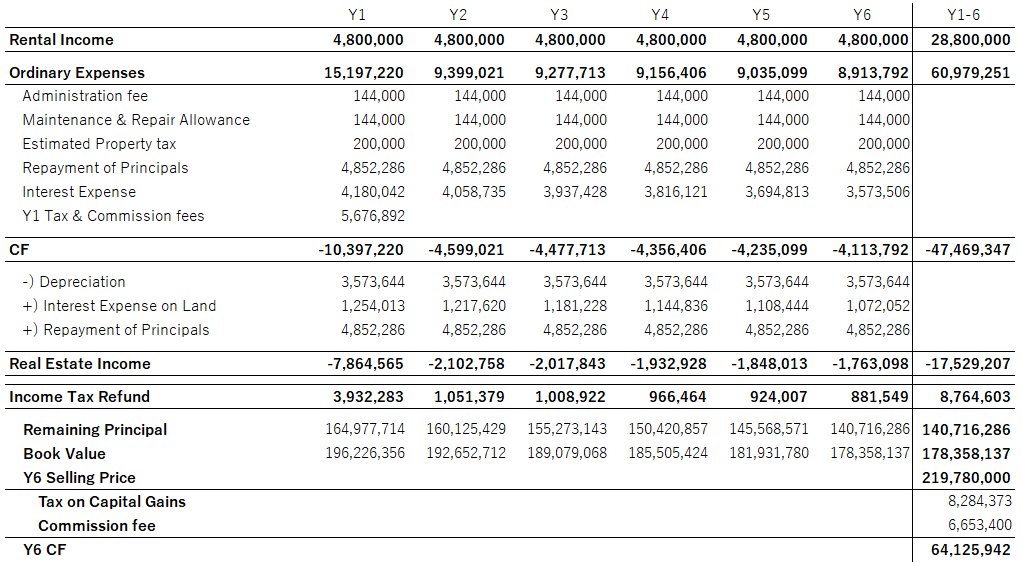
・Total Cash Flow (CF) Return: ¥25.42 million
・Operating CF (Real Estate CF): -¥47.46 million (Includes first-year brokerage fees and various taxes)
・Exit CF (Upon Sale): ¥64.12 million (Selling price after 6 years minus remaining loan balance, long-term capital gains tax, and brokerage fees)
・Tax Refund: ¥8.76 million
・Initial Capital Outlay: ¥38.48 million (Consists of a 15% down payment and brokerage fees; this excludes the ¥5.67 million that can be deducted as Year 1 expenses)
Based on these simulation results, if you hold the property for 6 years and successfully sell it at a 10% premium over the initial investment, you can project a net return of ¥25.42 million.
On the other hand, if you sell the property at the exact same price as the initial purchase, the Exit CF will drop to ¥48.74 million. While this is still enough to offset the cumulative negative operating cash flow from the 6-year holding period, your pure financial return will be limited strictly to the ¥8.76 million generated from tax refunds. Furthermore, if the property is sold at a 5% discount relative to the purchase price, the investment return will be virtually eliminated.
【Summary】 Tax Benefits and Pitfalls to Keep in Mind
For individuals in the ¥35 million income bracket whose income tax rate is near the highest bracket, strong returns can be expected if the amount of income tax refunded—generated by accounting deficits from real estate income—combined with the eventual selling price after holding the property for over 5 years exceeds the initial investment amount.
However, forecasting future resale prices from the present moment is extremely difficult, as it heavily depends on buyer demand for urban condos and the prevailing trends in housing or real estate loan interest rates.
If buyer demand in central Tokyo areas continues to be driven by households earning around ¥30 million—who typically secure financing at approximately 7 to 8 times their annual income—and if interest rates experience only a gradual rise, then executing this type of investment strategy may well be worth considering.
If you have any inquiries about this topic, please feel free to reach out to us for a consultation.